
Can donors trust you? Why integrity starts with your channel mix
It can be hard to know what to trust when we are bombarded with messages every day and it can feel like we’re living in a post truth era. So much of what we consume is fake – AI, deep fakes, lying politicians, fake news. So it's no wonder that we see decline in once-trusted institutions and authorities and that this extends to the charity sector.
The Edelman Trust barometer continues to show decline in trust for charities globally and in particular in certain countries such as the UK. NGOs trust is still higher than the media and government though!
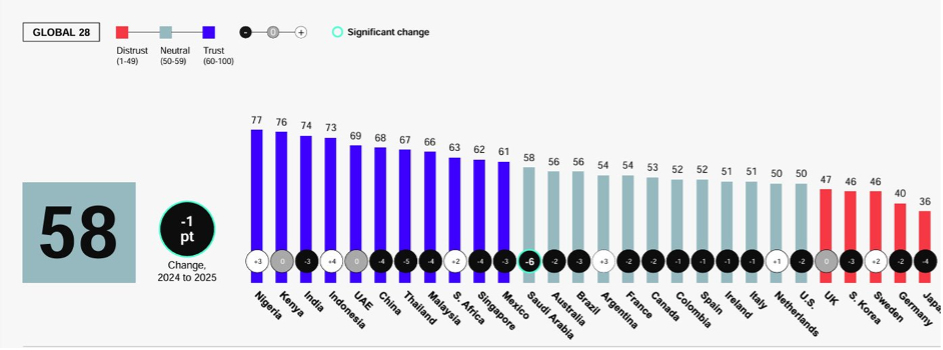
Source: Edelman 2025 Trust Barometer
How can charities combat this decline in trust? How can they reassure donors that they are still doing great work that needs to be supported? Donors need to trust that a donation they make to a cause will be spent wisely and that the money will get to where it's needed. So your messaging needs to build trust and confidence in your brand and cause.
With trust, it's not just important what you say, but where you say it. Some media channels are more trusted than others.
A recent report from Tapestry Research (2025) shows TV continues to be the most trusted channel.
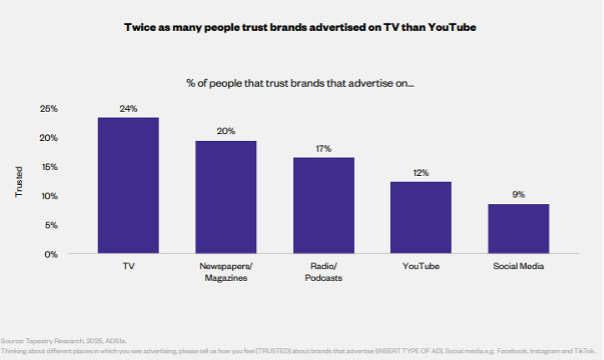
Source: Tapestry Research 2025
Why TV is trusted
TV is trusted as a more established channel held to high standards and pre-vetted by humans, with thorough regulation and strong restrictions on what can be aired. To get an advert on TV, it needs to go through Clearcast and all claims in the advert need to be substantiated. This is a reassuring and rigorous check in a world of spurious claims, online fraud and deep fakes.
As TV is viewable to millions of people, as opposed to more direct/one-to-one advertising, it has a sense of public accountability. If you see an advert on TV, it's more likely that friends and family will have seen it too, compared to an online advert with much narrower targeting. And for certain memorable campaigns like the John Lewis Christmas adverts, everyone sees it and talks about it!
Trust and legacy fundraising
Building trust is arguably most important for legacy giving; people are likely making the biggest gift they will make and, in some cases, the gift is only going to be received in many years time. The donor needs to trust that you will spend the gift well after they’ve gone.
When we’ve built legacy campaigns for Unicef, Save the Children, Breast Cancer Now, the Royal British Legion, the British Red Cross and so many others, we’ve been sure to gain deep audience insights into what matters most to donors when leaving a gift in their will. We’ve created campaigns that share their values and hopes for the future and ultimately build trust that this organisation will make the most of their legacy gift. All of these campaigns have built trust in these causes, establishing their longevity and impact. In many cases, the campaigns have referred directly to an organisation’s long history and tied this in with the donors’ own memories of key events in their lives. We also use social proof to show how many like-minded people have trusted them enough to leave a gift in their Will. But as the above research shows, it's not just the carefully crafted creative that is important but where potential donors are seeing them. These campaigns have often been integrated across many channels but we have also played to the strengths of TV for building trust. It's an audio-visual medium, which we know is vital to driving an emotional response and, of all media channels, it is the most likely to be remembered. We work closely with media partners to ensure these adverts reach our target audiences at home through the trustworthy channel of TV to gain that extra confidence in these wonderful causes.
If you're looking for answers on channel mix (not just TV), messaging, or deeper audience insight, I’d be happy to dig deeper into this data with you. Feel free to contact me at alex.wordsworth@dtvgroup.co.uk or helloDTV@dtvgroup.co.uk
Bio

Alex Wordsworth is Senior Strategic Planner at DTV. He has helped create successful DRTV and digital campaigns for many causes around the world.